The Adjacent Possible: How Innovation Actually Happens — and Why It Matters Now More Than Ever
A deeper look at Stuart Kauffman’s theory of human creativity, technological evolution, and how new ideas emerge from the edge of what already exists.
Innovation often feels like magic. A sudden spark. A flash of brilliance. A breakthrough nobody saw coming. But according to theoretical biologist Stuart Kauffman, creativity actually follows a surprisingly predictable pattern — one that shapes everything from human discovery to technological revolutions.
It’s a concept called the Adjacent Possible, and understanding it can help us make sense of how science advances, why society evolves, and where the next breakthrough may emerge.
🔮 What Is the Adjacent Possible?
The Adjacent Possible is the idea that at any moment, the world isn’t defined only by what exists — but also by what could immediately come into existence. It represents the next layer of possibilities just beyond the current state of things.
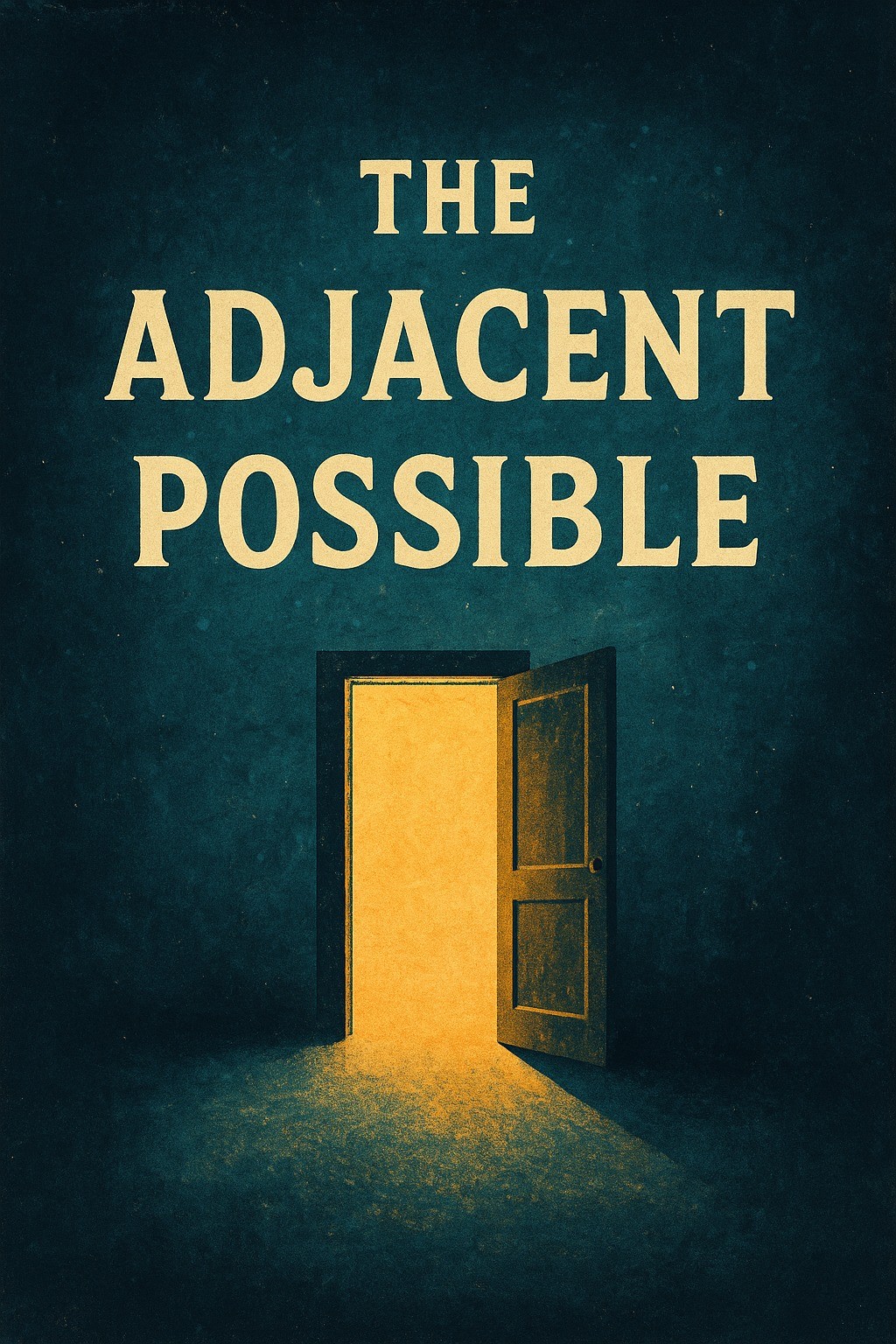
Think of it like standing in a room with several doors. Each door leads to a new room, and inside that new room are even more doors. Innovation happens not by leaping randomly into the unknown, but by opening the nearest possible door.
This means:
- Evolution follows accessible steps
- Creativity builds on what already exists
- Technology expands outward from its current frontier
- New possibilities emerge as we create new “rooms”
You can’t invent quantum computers in 1850.
You can’t build photonic processors without first developing silicon photonics.
The adjacent possible expands only when we open the next door.
🚪Why Innovation Happens in Leaps Instead of Smooth Lines
We tend to picture progress as a straight line. In reality, it jumps.
One breakthrough creates new possibilities — and those possibilities trigger even more breakthroughs.
Examples:
🔥 1. The smartphone
Before capacitive touch screens, mobile apps weren’t possible.
Before mobile apps, app stores weren’t possible.
Before app stores, ride-sharing and GPS-based services weren’t possible.
Each new innovation expanded the adjacent possible.
🔥 2. Quantum computing today
Before superconducting qubits, error correction wasn’t realistic.
Before error correction, fault-tolerant designs weren't practical.
Before photonic quantum chips, optical architectures weren’t accessible.
Each generation enables the next.
🧠The Adjacent Possible and Human Creativity
Kauffman argues that creativity is not just inspiration — it’s structure. Our brains explore the edge of what’s already imaginable.
For example:
- Writers build stories from cultural references and lived experiences.
- Engineers improve designs based on prior solutions.
- Scientists hypothesize using existing theories as scaffolding.
- Inventors remix old tools to create new ones.
We don’t invent out of thin air — we invent from the frontier of what we already understand.
Creativity happens when you step into the next accessible room.
🌎Why the Adjacent Possible Explains Global Innovation Waves
If you graph the history of human innovation, you’ll notice something shocking:
Progress accelerates — and accelerates fast.
Because:
- Every breakthrough expands the possibility space
- The larger the space, the more ideas can emerge
- More ideas → more adjacent possibilities → more breakthroughs
This compounding effect is why the last 200 years produced more technological progress than the previous 20,000.
We’ve opened a lot of doors — and each door reveals even more.
⚛️How This Concept Applies to Today’s Technology Boom
We’re currently experiencing a convergence of technologies that are massively expanding the adjacent possible:
- Quantum computing
- Optical / photonic systems
- AI and machine learning
- Robotics
- Biotechnology
- Material science
- High-performance computing
- Cloud automation
Each one unlocks new rooms — and these rooms connect to each other in unpredictable ways.
Example:
Quantum computing → new algorithms → new encryption standards → new AI architectures → new materials discovery.
This is why breakthroughs are coming faster than ever.
The adjacent possible isn’t just expanding — it’s exploding.
🧩Why You Can Never Predict the Next Breakthrough
According to Kauffman, innovation is fundamentally un-prestatable — meaning you can’t predict all the future possibilities from what exists now.
Example:
No one could predict the app store from the invention of the semiconductor.
Or predict blockchain from early networking protocols.
Or foresee photonic quantum computing from early laser research.
You can predict the next door.
But not the shape of the rooms beyond it.
The future isn’t a straight line — it’s an expanding web.
🌱How to Use the Adjacent Possible in Your Own Life
This isn’t just a scientific or technological idea.
It’s a personal innovation strategy.
Here’s how:
✔ 1. Start from where you are
You don’t need to leap ten steps ahead.
Just find the next door.
✔ 2. Build stepping stones
Every small skill or project opens new adjacent possibilities.
✔ 3. Combine existing ideas
Many breakthroughs come from connecting unrelated concepts.
✔ 4. Explore nonlinear opportunities
Diversify the “doors” available to you.
✔ 5. Stay curious
Curiosity expands your mental possibility space.
Small actions expand your future possibilities.
⚡The Adjacent Possible in Quantum Computing and AI
Finally, let’s bring this home to QPUWorld’s core focus areas.
Quantum computing is a perfect example of the adjacent possible:
- We couldn’t build quantum algorithms until we had stable qubits
- We couldn’t design photonic processors until silicon photonics matured
- We couldn’t explore quantum-AI hybrids until both fields evolved in parallel
Each advancement opens new possibilities.
AI works the same way:
- GPT-3 enabled thousands of AI startups
- GPT-4 enabled agentic AI systems
- GPT-4.1 + multimodal models enable autonomous workflows
- Every new capability expands what the next model can unlock
The two fields — quantum and AI — are actively expanding each other’s adjacent possibilities.
🌟Conclusion: The Future Belongs to Those Who Explore the Edge
The Adjacent Possible reminds us that innovation is not random.
It grows at the boundary between:
- what exists
- and what could exist next
We don’t need to predict the entire future.
We just need to recognize the “next doors” opening today.
And right now?
Between quantum breakthroughs, AI acceleration, and photonic technology, humanity is walking into the largest expansion of the adjacent possible in history.
The next rooms will be extraordinary.
📌Source
This article was inspired by “The Adjacent Possible” — a TED Talk by Stuart Kauffman.